Tallinn court fined 10 plaintiffs after an AI-assisted filing cited researchers and studies that did not exist
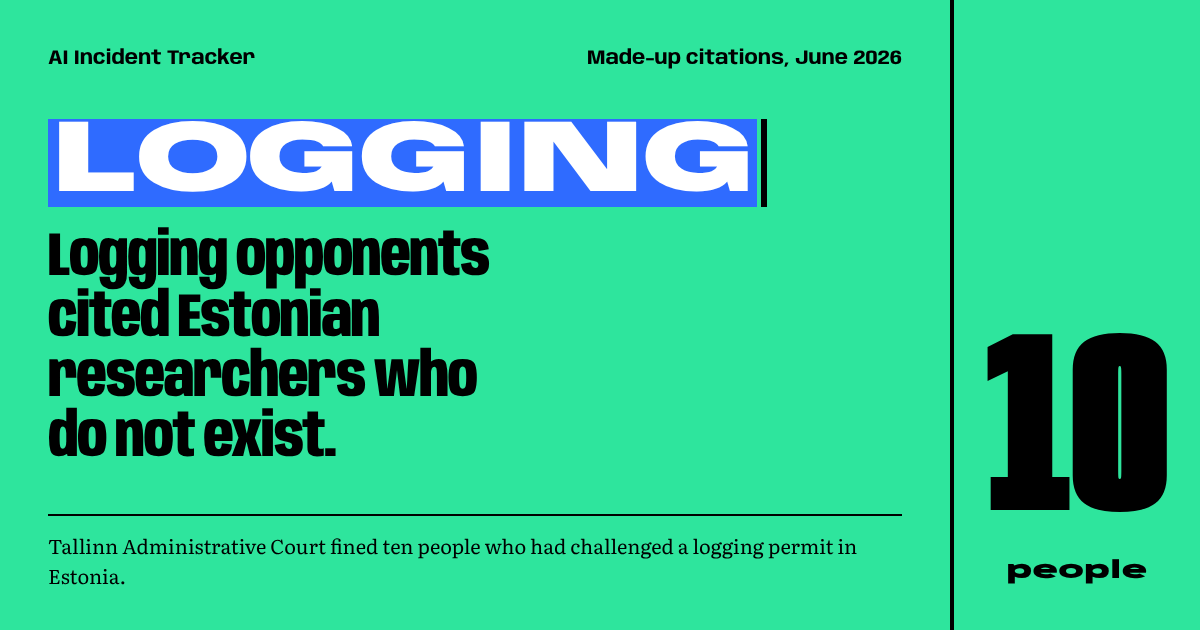
Tallinn Administrative Court fined ten people who had challenged a logging permit in Estonia. Their filing cited Estonian researchers who do not exist and studies that could not be found. One was fined €150 and nine were fined €50 each, Estonian courts announced in June 2026. The complainants said using AI is not banned and they had not meant to mislead. The court said AI may be used, but parties answer for what they submit.
A group of complainants went to Tallinn Administrative Court to challenge a permit to fell trees. To support their case, they submitted text citing research on the effects of clear-cutting.
The court found that the Estonian researchers named in the references do not exist and that the studies could not be found. It asked the complainants to explain how the text came about, gave them a chance to file the cited research, and warned that it could fine them for trying to mislead the court. They replied that using AI is not prohibited and that they had not intended to mislead.
The court fined one complainant €150 and nine others €50 each. It said parties may use AI but are responsible for the accuracy of what they tell the court. Court chairman Kaupo Kruusvee said judges increasingly see AI in filings and that references it produces must be checked against the original sources.
- Published
- June 25, 2026
- Problem
- References to researchers who do not exist
- Fines
- €150 and nine of €50
How it unfolded
- 2026
A filing cites researchers who do not exist.
- 2026
The court asks the complainants to explain.
- June 25, 2026
The fines are announced.
Provenance
Where each fact comes from, and what is still missing.
On the record
The court's announcement and ERR's reporting set out the false references, the complainants' response and the fines.Not yet confirmed
Which AI tool was used is not stated in the sources we read. Send us a sourceSources
- Official record
Riigikohus (Supreme Court of Estonia), June 25, 2026. Kohus trahvis kaebajaid tehisaru hooletu kasutamise eest. Read, archived copy - News report
ERR, June 25, 2026. Суд оштрафовал 10 человек за жалобы, подготовленные ИИ и содержавшие ложные сведения. Read, archived copy - News report
ERR, June 26, 2026. Estonian court fines plaintiffs over false AI-generated claims. Read, archived copy - News report
ERR, June 26, 2026. Kohus määras tehisaru loodud valeväidete tõttu kaebajatele trahvid. Read, archived copy - News report
15min.lt, June 26, 2026. Estijoje teismas pirmą kartą skyrė baudas už dirbtinio intelekto išgalvotas nuorodas. Read, archived copy - Incident index
AI Incident Database, June 25, 2026. AIID incident #1733. Read
Rewritten and checked Nov 24, 2026. First published Nov 19, 2026.
Status history
Changes to this exhibit's status, with the date and what changed it.
- Nov 24, 2026Written up in full and checked against the court's announcement and ERR. The court's release is now typed as an official record. Status: official record.Riigikohus (Supreme Court of Estonia); ERR; ERR
- Nov 19, 2026Imported from the AI Incident Database (incident 1733) with the reports it lists.AI Incident Database
- Nov 19, 2026Checked against ERR and summarized in our own words; the courts' own release and ERR's English report could not be opened.ERR
Questions visitors ask
Why did an Estonian court fine the complainants?
Their filing cited Estonian researchers who do not exist and studies that could not be found, which the court treated as misleading it.
How large were the fines?
One complainant was fined €150 and nine were fined €50 each.
Did the court ban AI?
No. It said parties may use AI but must check that the sources they cite are real.
Take it with you
Share the cover
Cite this exhibit
AI Incident Tracker. (2026, November 24). Tallinn court fined 10 plaintiffs after an AI-assisted filing cited researchers and studies that did not exist (AIT-1823). https://aiincidenttracker.com/AIT-1823
In the data
DownloadsUp next
More like this
See the room- May 22, 2025The White House MAHA report cited studies that do not exist, and some citations carried ChatGPT's "oaicite" markerMade-up citations
- Oct 2024Alaska education commissioner used generative AI for policy citations, and some cited studies appear not to existMade-up citations
- Sep 2024South African court found that only two of nine cases cited by an Umvoti mayor's lawyers existed, and called relying on AI for research irresponsibleMade-up citations
- Mar 1, 2023Lawyers in Mata v. Avianca cited six court decisions ChatGPT invented and were fined $5,000Made-up citations