Lawyers in Mata v. Avianca cited six court decisions ChatGPT invented and were fined $5,000
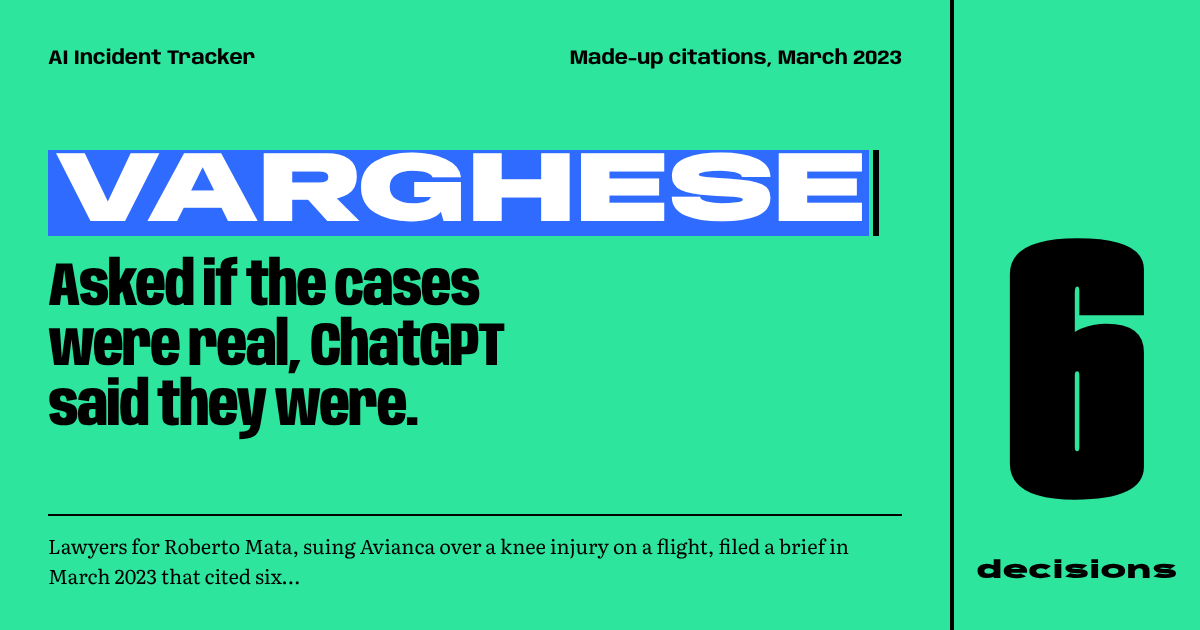
Lawyers for Roberto Mata, suing Avianca over a knee injury on a flight, filed a brief in March 2023 that cited six court decisions that do not exist. Attorney Steven Schwartz had found them with ChatGPT, which told him they were real. In June 2023 Judge P. Kevin Castel found bad faith and fined the two lawyers and their firm $5,000. He also dismissed Mata's suit as filed too late.
Roberto Mata sued Avianca, saying a metal serving cart struck his left knee on a flight from El Salvador to New York's JFK Airport. Avianca asked the federal court in Manhattan to dismiss the case as filed too late.
On March 1, 2023, Mata's lawyers at Levidow, Levidow & Oberman opposed with a brief that leaned on decisions such as Varghese v. China Southern Airlines. On March 15 Avianca's lawyers told the court they could not find several of them. Six turned out not to exist.
In a May 25 affidavit, attorney Steven A. Schwartz said he had found the cases using ChatGPT. Screenshots showed that when he asked whether they were real, ChatGPT said they could be found on Westlaw and LexisNexis. Peter LoDuca, the lawyer of record in the federal case, had filed the papers.
On June 22, 2023, Judge P. Kevin Castel found bad faith on the part of both lawyers, citing conscious avoidance and false and misleading statements to the court. He fined them and their firm $5,000 and ordered them to send his opinion to Mata and to each real judge named as the author of a fake opinion. The same day he dismissed Mata's suit as filed too late.
- Case
- Mata v. Avianca, Inc., 22-cv-1461 (PKC)
- Judge
- P. Kevin Castel
- Signed
- June 22, 2023
- Finding
- Bad faith on the part of the individual lawyers
- Penalty
- $5,000, jointly and severally
How it unfolded
- Mar. 1, 2023
Mata's lawyers file a brief citing decisions ChatGPT supplied.
- Mar. 15, 2023
Avianca's lawyers say they cannot find several of them.
- Apr. 25, 2023
Excerpts of the supposed decisions are filed with the court.
- May 4, 2023
The judge orders the lawyers to explain.
- May 25, 2023
Schwartz's affidavit says the cases came from ChatGPT.
- June 8, 2023
Sanctions hearing.
- June 22, 2023
A $5,000 sanction; Mata's suit is dismissed as untimely.
“It promotes cynicism about the legal profession and the American judicial system.”
Provenance
Where each fact comes from, and what is still missing.
On the record
The court's opinion and order on sanctions of June 22, 2023 sets out the filings, the six fake decisions, the hearing and the penalty. Its May 4 order to show cause lists the citations it could not find.Not yet confirmed
Mata's injury claim itself was never tested on its merits; the court dismissed the suit as filed too late. Send us a sourceSources
- Court record
U.S. District Court, Southern District of New York, June 22, 2023. Mata v. Avianca, Inc., opinion and order on sanctions (ECF 54). Read, archived copy - Court record
U.S. District Court, Southern District of New York, May 4, 2023. Mata v. Avianca, Inc., order to show cause (ECF 31). Read, archived copy - News report
Bloomberg Law, June 22, 2023. Phony ChatGPT Brief Leads to $5,000 Fine for NY Lawyers. Read - News report
The New York Times, May 27, 2023. Here’s What Happens When Your Lawyer Uses ChatGPT. Read, archived copy - News report
Forbes, May 27, 2023. Lawyer Uses ChatGPT In Federal Court And It Goes Horribly Wrong. Read, archived copy - News report
CNN, May 27, 2023. Lawyer apologizes for fake court citations from ChatGPT. Read, archived copy - News report
Mashable, May 27, 2023. A lawyer used ChatGPT for legal filing. The chatbot cited nonexistent cases it just made up. Read, archived copy - News report
The Verge, May 27, 2023. A lawyer used ChatGPT and now has to answer for its ‘bogus’ citations. Read, archived copy - News report
Igor Bonifacic, Engadget, May 28, 2023. A lawyer faces sanctions after he used ChatGPT to write a brief riddled with fake citations. Read - Incident index
AI Incident Database, May 4, 2023. AIID incident #541. Read
Rewritten and checked Nov 24, 2026. First published Nov 19, 2026.
Status history
Changes to this exhibit's status, with the date and what changed it.
- Nov 24, 2026Written up in full and checked against the court's order to show cause and its opinion and order on sanctions. Status: official record.U.S. District Court, Southern District of New York
- Nov 19, 2026Imported from the AI Incident Database (incident 541) with the reports it lists.AI Incident Database
- Nov 19, 2026Checked against Engadget and summarized in our own words.Engadget
Questions visitors ask
What happened in Mata v. Avianca?
Lawyers for a passenger suing the airline Avianca filed a brief citing six court decisions that ChatGPT had made up. The judge sanctioned the two lawyers and their firm in June 2023.
Which fake cases were cited?
The court listed Varghese v. China Southern Airlines, Shaboon v. Egyptair, Petersen v. Iran Air, Martinez v. Delta Airlines, Estate of Durden v. KLM Royal Dutch Airlines and Miller v. United Airlines.
Did ChatGPT say the cases were real?
Yes. Screenshots filed with the court show ChatGPT telling Schwartz the cases could be found in legal research databases such as Westlaw and LexisNexis.
What sanctions did the lawyers get?
A $5,000 penalty, shared by Steven Schwartz, Peter LoDuca and their firm, plus letters to Mata and to each judge falsely named as an author. The court found bad faith on the part of both lawyers.
Take it with you
Share the cover
Cite this exhibit
AI Incident Tracker. (2026, November 24). Lawyers in Mata v. Avianca cited six court decisions ChatGPT invented and were fined $5,000 (AIT-0688). https://aiincidenttracker.com/AIT-0688
In the data
DownloadsUp next
More like this
See the room- Feb 9, 2026Appeals court sanctioned a lawyer $1,000 over an AI-drafted brief citing nonexistent cases in a Frontier Airlines suitMade-up citations
- Feb 2, 2026Kansas federal judge fined four lawyers $12,000 over ChatGPT-made citations in Lexos Media patent caseMade-up citations
- May 1, 2025Ontario lawyer who cited AI-invented cases in Ko v. Li was referred for criminal contempt and suspended for six monthsMade-up citations
- May 2025Federal judge removed three Butler Snow lawyers from an Alabama prison case over ChatGPT-invented citationsMade-up citations