Arizona appeals court sanctioned a self-represented man whose probate appeal cited cases that do not exist
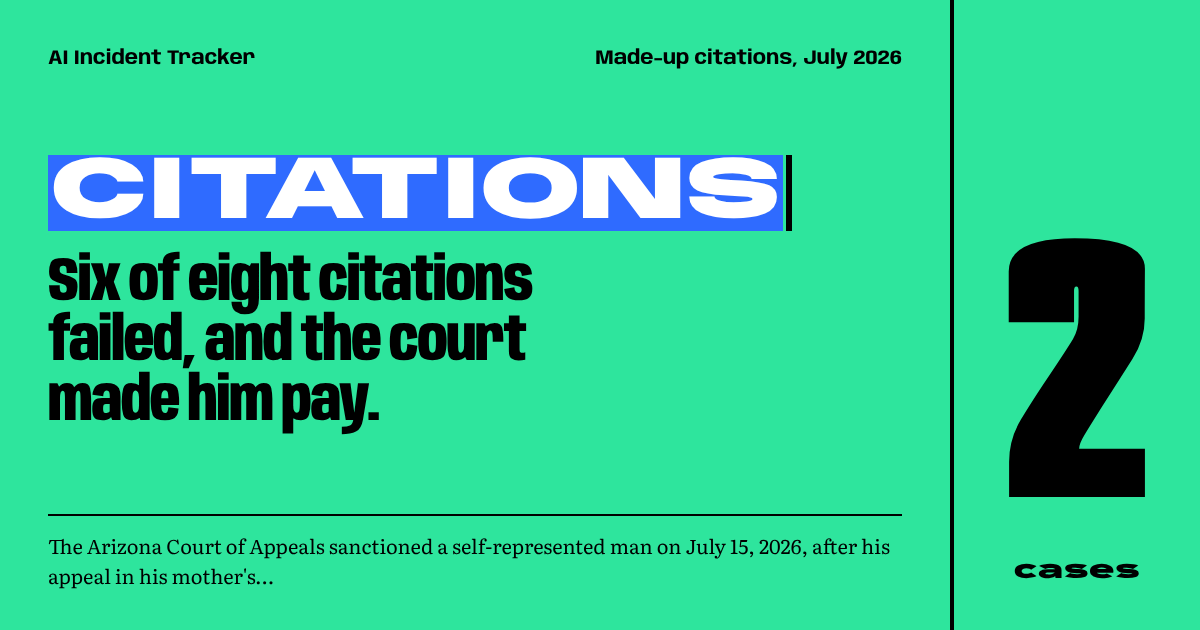
The Arizona Court of Appeals sanctioned a self-represented man on July 15, 2026, after his appeal in his mother's probate case relied on faulty citations. He admitted using AI-assisted research tools and not checking the citations, the court said. Six of his eight citations were deficient, including two cases that do not exist, the opinion says. The court struck those citations, upheld his sister's appointment as personal representative and ordered him to pay the share of her fees the bad citations caused.
Gloria Acciavatti died in June 2023 at 93, leaving three adult children. One daughter petitioned to become the estate's personal representative, and a trial court appointed her in July 2025. Her brother, representing himself, appealed.
His opening brief contained eight citations. The court found six deficient, including two cases that do not exist, and the brief cited nothing in the trial record. Ordered to explain under oath, he said he had done internet research using AI-assisted tools, had not used the court's materials for self-represented litigants, and had done nothing to verify the citations. He said the errors were unintentional.
In a unanimous opinion by Judge Brian Furuya, the court held that citing a hallucinated case is sanctionable regardless of intent, relying on its appellate rules, a fee statute and its inherent authority. It said using generative AI is not objectionable in itself, but filers remain responsible for checking what it produces. The court struck the bad citations, affirmed the appointment because his arguments were waived, and ordered him to pay the part of his sister's attorneys' fees the citations caused.
- Filed
- July 15, 2026
- Citations
- 8 in the brief; 6 deficient; 2 nonexistent
- Holding
- Hallucinated citations sanctionable regardless of intent
- Sanction
- Fees caused by the citations
How it unfolded
- July 2025
A trial court appoints the daughter as personal representative.
- 2025
Her brother files an appeal brief with eight citations.
- Feb. 2026
The court orders him to explain the citations.
- July 15, 2026
The court sanctions him and affirms.
“an unreliable narrator and researcher”
Provenance
Where each fact comes from, and what is still missing.
On the record
The court's opinion sets out the citations, his explanation and the sanction.Not yet confirmed
Which AI tools he used is not named in the opinion. Send us a sourceSources
- News report
newsfromthestates.com, July 16, 2026. AZ Court of Appeals: Citing fake AI-generated cases can get you sanctioned, no matter your intent. Read, archived copy - Official record
Arizona Court of Appeals, July 15, 2026. In the Matter of the Estate of Acciavatti, No. 1 CA-CV 25-0606 PB, opinion. Read, archived copy - Incident index
AI Incident Database, September 11, 2025. AIID incident #1600. Read
Rewritten and checked Nov 24, 2026. First published Nov 19, 2026.
Status history
Changes to this exhibit's status, with the date and what changed it.
- Nov 24, 2026Written up in full and checked against the court's opinion and States Newsroom's report. Appellant described without his name. Status: official record.Arizona Court of Appeals; newsfromthestates.com
- Nov 19, 2026Imported from the AI Incident Database (incident 1600) with the reports it lists.AI Incident Database
- Nov 19, 2026Checked against the Arizona Court of Appeals opinion and summarized in our own words.Arizona Court of Appeals
Questions visitors ask
What did the Arizona Court of Appeals decide about AI citations?
That citing a hallucinated case is sanctionable whether or not the filer meant to mislead, and that filers must verify what AI tools produce.
Who was sanctioned?
A self-represented man appealing a probate ruling in his mother's estate. Six of his eight citations were deficient, including two fake cases.
What was the sanction?
The court struck the bad citations and ordered him to pay the share of his sister's attorneys' fees the citations caused.
Take it with you
Share the cover
Cite this exhibit
AI Incident Tracker. (2026, November 24). Arizona appeals court sanctioned a self-represented man whose probate appeal cited cases that do not exist (AIT-1690). https://aiincidenttracker.com/AIT-1690
In the data
DownloadsUp next
More like this
See the room- Aug 12, 2025D.C. Court of Appeals struck a Deutsche Bank trust company's brief that cited four cases found with Google's AIMade-up citations
- Sep 2024South African court found that only two of nine cases cited by an Umvoti mayor's lawyers existed, and called relying on AI for research irresponsibleMade-up citations
- Jun 25, 2026Tallinn court fined 10 plaintiffs after an AI-assisted filing cited researchers and studies that did not existMade-up citations
- Jun 3, 2025Crown Prosecution Service apologized after its extradition appeal filings cited two nonexistent casesMade-up citations