Stanford expert Jeff Hancock's declaration in a Minnesota deepfake case cited articles GPT-4o made up
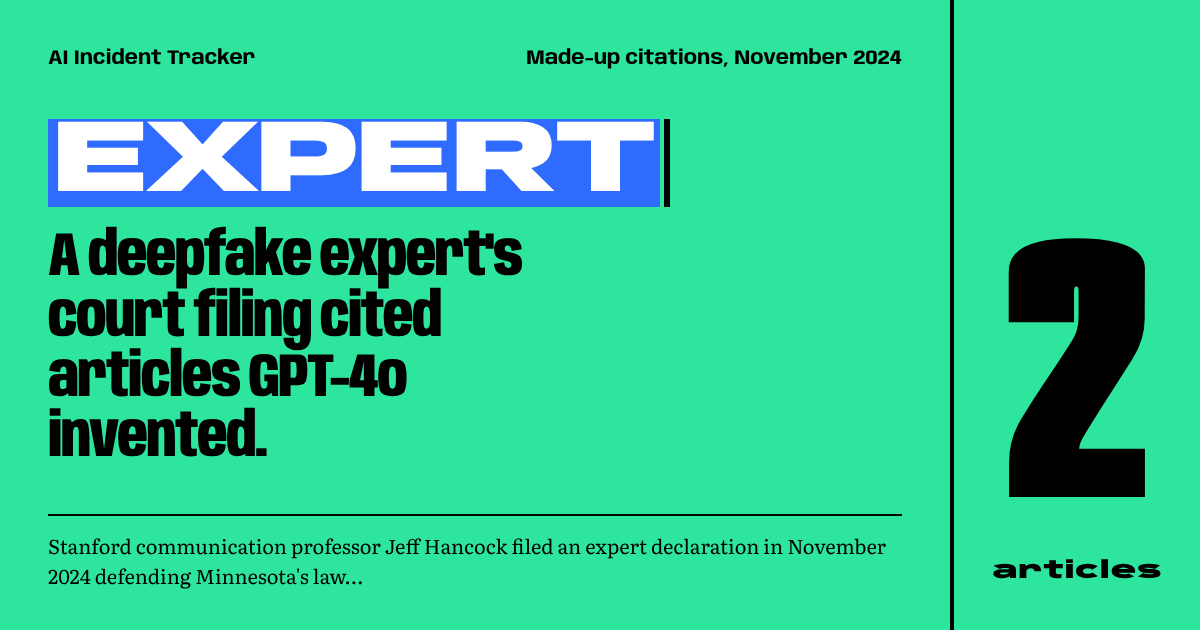
Stanford communication professor Jeff Hancock filed an expert declaration in November 2024 defending Minnesota's law against election deepfakes. It cited two academic articles that do not exist and miscredited the authors of a third, errors he said came from using GPT-4o while drafting. On January 10, 2025, Judge Laura Provinzino excluded the declaration, saying the fake citations shattered his credibility. She also refused to let the state file a corrected version for the pending motion.
A YouTuber and a Minnesota state legislator sued to block the state's 2023 law against deepfakes in elections. Defending the law, Attorney General Keith Ellison filed a declaration from Jeff Hancock, a Stanford professor who studies misinformation, on the dangers of AI and deepfakes.
The plaintiffs found that the declaration cited a study that does not exist. Hancock later acknowledged two nonexistent articles and a third with the wrong authors, and explained that GPT-4o had inserted the citations while he used it to help draft. The attorney general's office said it had not known and asked to file a corrected declaration.
On January 10, 2025, Judge Laura Provinzino excluded the Hancock declaration from her ruling on the preliminary injunction and denied the corrected version as moot. She noted the irony of an expert on the dangers of AI relying too heavily on AI, in a case about those dangers.
- Date
- January 10, 2025
- Errors
- Two nonexistent articles; one miscited
- Tool
- GPT-4o
- Ruling
- Declaration excluded from the injunction ruling
How it unfolded
- Nov. 1, 2024
The expert declaration is filed.
- Nov. 2024
The plaintiffs flag a study that does not exist.
- Dec. 2024
The expert says GPT-4o inserted the citations.
- Jan. 10, 2025
The judge excludes the declaration.
“shatters his credibility with this Court”
Provenance
Where each fact comes from, and what is still missing.
On the record
The court's order records the fake citations, the expert's explanation and the exclusion.Not yet confirmed
Nothing material is in dispute in the sources we read. Send us a sourceSources
- Official record
U.S. District Court for the District of Minnesota (via Justia), January 10, 2025. Kohls et al v. Ellison et al, Doc. 46. Read - News report
minnesotareformer.com, November 20, 2024. Misinformation expert cites non-existent sources in Minnesota deep fake case • Minnesota Reformer. Read, archived copy - News report
Grace Zhao, The Stanford Daily, December 4, 2024. Stanford misinformation expert admits to ChatGPT ‘hallucinations’ in court statement. Read, archived copy - Incident index
AI Incident Database, November 1, 2024. AIID incident #852. Read
Rewritten and checked Nov 24, 2026. First published Nov 19, 2026.
Status history
Changes to this exhibit's status, with the date and what changed it.
- Nov 24, 2026Written up in full and checked against the court's January 2025 order, the Minnesota Reformer and The Stanford Daily. Outcome added. Status: official record.U.S. District Court for the District of Minnesota (via Justia); minnesotareformer.com; The Stanford Daily
- Nov 19, 2026Imported from the AI Incident Database (incident 852) with the reports it lists.AI Incident Database
- Nov 19, 2026Checked against The Stanford Daily and summarized in our own words.The Stanford Daily
Questions visitors ask
What happened with Jeff Hancock's declaration?
It cited two academic articles that do not exist and miscredited a third, after he used GPT-4o to help draft it.
What did the court do?
It excluded the declaration from its preliminary-injunction ruling and declined to accept a corrected version.
What was the case about?
A challenge to Minnesota's 2023 law against election deepfakes.
Take it with you
Share the cover
Cite this exhibit
AI Incident Tracker. (2026, November 24). Stanford expert Jeff Hancock's declaration in a Minnesota deepfake case cited articles GPT-4o made up (AIT-0997). https://aiincidenttracker.com/AIT-0997
In the data
DownloadsUp next
More like this
See the room- Oct 2024Alaska education commissioner used generative AI for policy citations, and some cited studies appear not to existMade-up citations
- Jul 15, 2026Arizona appeals court sanctioned a self-represented man whose probate appeal cited cases that do not existMade-up citations
- Jun 25, 2026Tallinn court fined 10 plaintiffs after an AI-assisted filing cited researchers and studies that did not existMade-up citations
- Feb 9, 2026Appeals court sanctioned a lawyer $1,000 over an AI-drafted brief citing nonexistent cases in a Frontier Airlines suitMade-up citations