UK Home Office tests found its police face-search tool gave more false matches for Black and Asian people
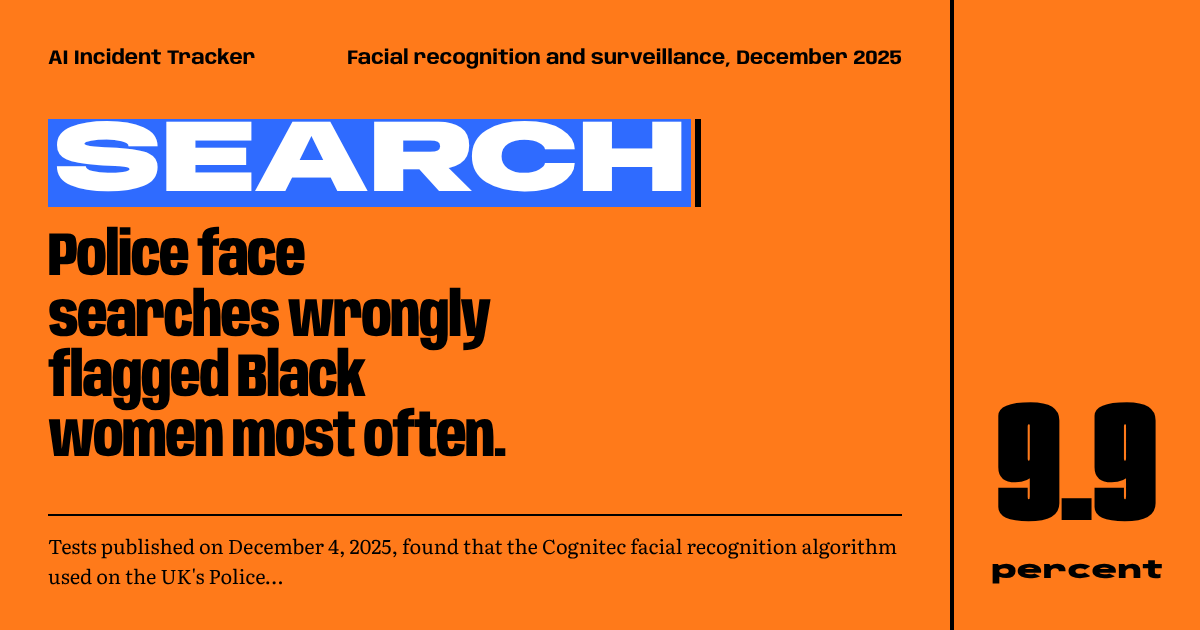
Tests published on December 4, 2025, found that the Cognitec facial recognition algorithm used on the UK's Police National Database gave false matches far more often for some groups. At a lower accuracy setting, the National Physical Laboratory found rates of 5.5% for Black subjects, 4% for Asian and 0.04% for white subjects, and 9.9% for Black women. The Home Office said it had procured a new algorithm, to be trialled in early 2026. The Information Commissioner's Office said it had not been told of the bias earlier.
UK police forces can search an image of an unknown suspect, from CCTV or a phone, against about 19 million custody images in the Police National Database, using a facial recognition algorithm from Cognitec. They run around 25,000 such searches a month.
The Home Office commissioned the National Physical Laboratory to test the algorithm. Its report, published December 4, 2025, found that at a face-match threshold of 0.8 the system wrongly included Black subjects 5.5% of the time, Asian subjects 4% and white subjects 0.04%. For Black women the rate was 9.9%. The Home Office said that at the setting police use, the right person is returned in over 99% of searches when they are in the database.
The Home Office said it had procured a new algorithm without significant demographic differences, to be tested operationally in early 2026, and police reissued guidance on manual checks. An inspection was planned. The Information Commissioner's Office said it was disappointed not to have been told about the bias earlier and asked the Home Office for urgent clarity.
- Dated
- October 2025 (published December 4, 2025)
- False matches at 0.8
- Black 5.5%, Asian 4.0%, white 0.04%
- Black women
- 9.9%
- Searches
- About 25,000 a month
How it unfolded
- 2013
Face search is added to the Police National Database.
- Oct. 2025
The National Physical Laboratory completes its tests.
- Dec. 4, 2025
The Home Office publishes the results.
- Dec. 5, 2025
The data watchdog says it was not told earlier.
“it's disappointing that we had not previously been told about this”
Provenance
Where each fact comes from, and what is still missing.
On the record
The National Physical Laboratory's report and the Home Office's summary set out the false match rates and the planned changes.Not yet confirmed
How many wrong identifications reached investigations is not stated in the sources we read. Send us a sourceSources
- Official record
Information Commissioner's Office, December 5, 2025. Statement on the National Physical Laboratory facial recognition technology report. Read - Official record
Home Office, December 4, 2025. Summary: accuracy and equitability evaluation of Cognitec FaceVACS-DBScan ID v5.5. Read - Official record
National Physical Laboratory (published by the Home Office), December 4, 2025. Facial Recognition Technologies: Accuracy and Equitability Evaluation of Cognitec FaceVACS-DBScan ID v5.5 (Report 4153). Read - News report
Financial Times, December 5, 2025. Facial recognition technology used by UK police is biased, Home Office admits. Read, archived copy - News report
The Guardian, December 10, 2025. UK police forces lobbied to use biased facial recognition technology. Read - News report
The Guardian, December 5, 2025. Home Office admits facial recognition tech issue with black and Asian subjects. Read - News report
The Telegraph, December 5, 2025. Facial recognition cameras ‘more likely to wrongly flag black and Asian people’. Read, archived copy - News report
Connor Jones, The Register, December 8, 2025. Home Office kept police facial recognition flaws to itself, UK data watchdog fumes. Read, archived copy - News report
Pramod Thomas, Eastern Eye, December 5, 2025. Home Office admits tech bias as facial recognition checks fail minorities. Read, archived copy - Incident index
AI Incident Database, December 5, 2025. AIID incident #1305. Read, archived copy
Rewritten and checked Nov 24, 2026. First published May 25, 2026.
Status history
Changes to this exhibit's status, with the date and what changed it.
- Nov 24, 2026Written up in full and checked against the National Physical Laboratory report, the Home Office summary, the ICO statement and The Guardian. Status: official record.National Physical Laboratory (published by the Home Office); Home Office; Information Commissioner's Office; The Guardian
- Nov 19, 2026Checked against The Register and Eastern Eye and summarized in our own words. Date corrected from 2025-12-05 to 2025-12-04, when the test results were published.The Register; Eastern Eye
- May 25, 2026Logged from the AI Incident Database index and the news reports it cites.AI Incident Database
Questions visitors ask
What did the tests of the UK police face search find?
At one setting, the Police National Database algorithm wrongly included Black subjects 5.5% of the time and white subjects 0.04%, with the highest rate, 9.9%, for Black women.
What is the Home Office doing?
It procured a new algorithm due for operational testing in early 2026, and police reissued guidance on manual checks.
What did the data regulator say?
The ICO said it was disappointed not to have been told earlier and asked the Home Office for urgent clarity.
Take it with you
Share the cover
Cite this exhibit
AI Incident Tracker. (2026, November 24). UK Home Office tests found its police face-search tool gave more false matches for Black and Asian people (AIT-0128). https://aiincidenttracker.com/AIT-0128
Up next
More like this
See the room- Jan 13, 2025Washington Post found eight people wrongfully arrested after police relied on facial recognition matchesFacial recognition and surveillance
- Dec 19, 2023FTC banned Rite Aid from using facial recognition for five years over false shoplifting matchesFacial recognition and surveillance
- Sep 2023Reno casino's facial recognition matched a truck driver to a banned man; police arrested him, and he is suing the officer and the cityFacial recognition and surveillance
- Aug 2017Met Police face recognition trial at the 2017 Notting Hill Carnival made about 35 false matches, Liberty saidFacial recognition and surveillance