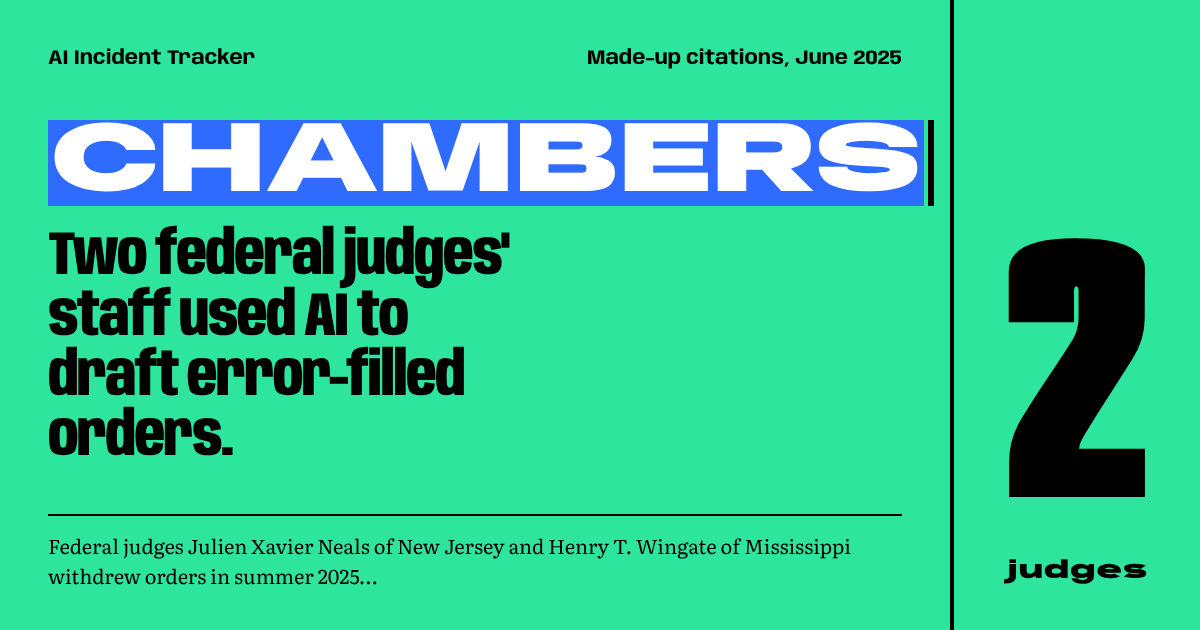
Two federal judges said staff use of ChatGPT and Perplexity led to error-filled rulings in New Jersey and Mississippi
Federal judges Julien Xavier Neals of New Jersey and Henry T. Wingate of Mississippi withdrew orders in summer 2025 after lawyers flagged nonexistent quotations and references to people unconnected to the cases. Responding to Senate Judiciary Committee Chairman Chuck Grassley in October 2025, Neals said a law school intern had used ChatGPT and Wingate said a law clerk had used Perplexity. Neals adopted a written ban on staff using AI to draft, and Wingate added a second review of drafts.
On June 30, 2025, Judge Julien Xavier Neals of New Jersey issued an opinion in a securities class action against CorMedix that contained quotations that did not exist. On July 20, Judge Henry T. Wingate of Mississippi issued a temporary restraining order that referred to parties, allegations and quotes unconnected to the case. Both orders were withdrawn and replaced after lawyers pointed out the errors.
On October 6, Senate Judiciary Committee Chairman Chuck Grassley wrote to both judges asking whether they or their staff had used generative AI. In replies sent through the Administrative Office of the U.S. Courts, Neals said a law school intern had used ChatGPT for research, and Wingate said a law clerk had used Perplexity as a drafting assistant.
Neals said his chambers now has a written policy barring clerks and interns from using AI to draft opinions or orders, plus a multi-level review. Wingate now requires a second independent review of drafts and printouts of every cited case. Grassley made the replies public on October 23 and called for permanent judiciary rules on AI.
- Released
- October 23, 2025
- Admission
- Staff used generative AI to draft the orders
- Fixes
- Written AI policy; second review; printed citations
How it unfolded
- June 30, 2025
A New Jersey opinion contains fake quotations.
- July 20, 2025
A Mississippi order cites unrelated parties.
- Oct. 6, 2025
Sen. Grassley asks both judges about AI use.
- Oct. 23, 2025
Their replies admitting staff AI use are released.
Provenance
Where each fact comes from, and what is still missing.
On the record
Both judges told the Senate Judiciary Committee, through the courts' administrative office, that staff use of AI produced the errors.Not yet confirmed
Whether either order affected the parties before it was withdrawn is not described in the sources we read. Send us a sourceSources
- Official record
U.S. Senate Committee on the Judiciary, October 6, 2025. Grassley Scrutinizes Federal Judges' Apparent AI Use in Drafting Error-Ridden Rulings. Read - Official record
U.S. Senate Committee on the Judiciary, October 23, 2025. Grassley Releases Judges' Responses Owning Up to AI Use, Calls for Continued Oversight and Regulation. Read - News report
Justin Henry, Bloomberg Law, October 23, 2025. Judges Admit to Using AI After Made-Up Rulings Called Out (1). Read, archived copy - News report
The Washington Post, October 29, 2025. Federal judges using AI filed court orders with false quotes, fake names. Read, archived copy - News report
Madison Alder, FedScoop, October 23, 2025. Use of Perplexity, ChatGPT behind error-ridden orders, federal judges say. Read, archived copy - Incident index
AI Incident Database, June 30, 2025. AIID incident #1252. Read
Rewritten and checked Nov 24, 2026. First published Nov 19, 2026.
Status history
Changes to this exhibit's status, with the date and what changed it.
- Nov 24, 2026Written up in full and checked against the Senate Judiciary Committee's releases, Bloomberg Law and The Washington Post. Date set to the first withdrawn order. Status: official record.U.S. Senate Committee on the Judiciary; U.S. Senate Committee on the Judiciary; Bloomberg Law; The Washington Post
- Nov 19, 2026Imported from the AI Incident Database (incident 1252) with the reports it lists.AI Incident Database
- Nov 19, 2026Checked against Bloomberg Law and FedScoop and summarized in our own words. FedScoop added as a source. Date changed from 2025-06-30 to 2025: the sources give July 20, 2025 for Wingate's order but no date for Neals's, so only the year is given.Bloomberg Law; FedScoop
Questions visitors ask
Which judges admitted AI caused errors in their orders?
Judge Julien Xavier Neals of New Jersey and Judge Henry T. Wingate of Mississippi, in letters answering Sen. Chuck Grassley in October 2025.
Which AI tools were used?
Neals said an intern used ChatGPT; Wingate said a law clerk used Perplexity.
What changed afterward?
Neals barred his clerks and interns from using AI to draft, and Wingate required a second review and printouts of all cited cases.
Take it with you
Share the cover
Cite this exhibit
AI Incident Tracker. (2026, November 24). Two federal judges said staff use of ChatGPT and Perplexity led to error-filled rulings in New Jersey and Mississippi (AIT-1397). https://aiincidenttracker.com/AIT-1397
In the data
DownloadsUp next
More like this
See the room- May 2025Federal judge removed three Butler Snow lawyers from an Alabama prison case over ChatGPT-invented citationsMade-up citations
- May 22, 2025The White House MAHA report cited studies that do not exist, and some citations carried ChatGPT's "oaicite" markerMade-up citations
- May 2023Colorado lawyer Zachariah Crabill was suspended after citing fake ChatGPT cases and blaming an internMade-up citations
- Mar 1, 2023Lawyers in Mata v. Avianca cited six court decisions ChatGPT invented and were fined $5,000Made-up citations