FTC said the Ever photo app ran facial recognition on users' photos by default, and its maker settled
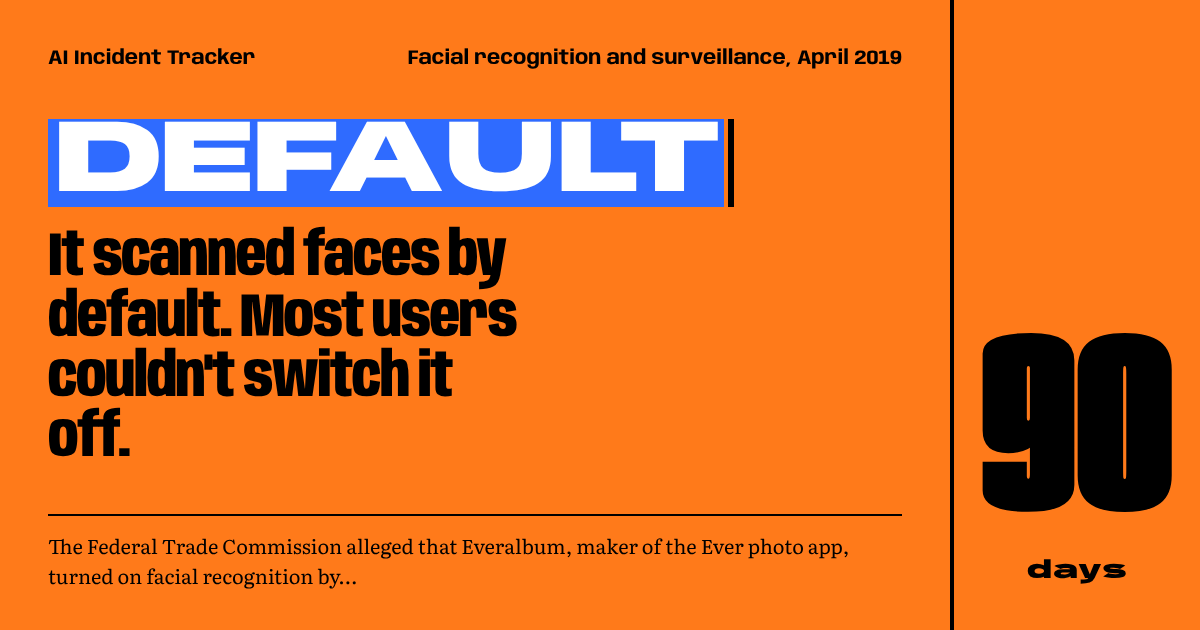
The Federal Trade Commission alleged that Everalbum, maker of the Ever photo app, turned on facial recognition by default in 2017. Most users could not turn it off until April 2019. The FTC said the company used faces from users' photos to build technology it also sold to business customers. Under an order finalized in May 2021, Everalbum had to delete that face data and the models and algorithms built with it.
Everalbum, a California company, ran Ever, an app for storing photos and videos in the cloud. In February 2017 it launched Friends, a feature that used facial recognition to group users' photos by the faces in them. The Federal Trade Commission said the feature was switched on by default for all mobile users, with no way to turn it off.
From May 2018, users in Illinois, Texas, Washington and the European Union, places with biometric privacy laws, were asked first and could say no. Everyone else got face recognition automatically until April 2019, the FTC alleged, even though a help page suggested it was used only with consent.
The FTC also said Everalbum combined faces taken from users' photos with public datasets to develop its own face recognition, which it used in the app and in services sold to business customers under the name Paravision, formerly Ever AI. And although it promised to delete the content of deactivated accounts, it kept those photos and videos until at least October 2019. The Ever app shut down on August 31, 2020.
Everalbum settled in January 2021, and the FTC finalized the order in May 2021. The company had to get express consent before using face recognition on people's photos, delete photos and videos from deactivated accounts, delete face data from users who had not consented, and delete face recognition models and algorithms developed with users' photos or videos. Commissioner Rohit Chopra called the model deletion an important course correction.
- Final
- May 2021
- Consent
- Express consent before using face recognition
- Delete
- Face recognition models and algorithms developed with users' photos or videos
- Also delete
- Deactivated users' photos and videos, within 30 days
- And
- Face data from users who did not consent, within 90 days
How it unfolded
- Feb. 2017
Friends launches with face recognition on by default.
- May 2018
Users in Illinois, Texas, Washington and the EU get a choice.
- Apr. 2019
Other users can finally turn it off.
- May 2019
NBC News reports on Ever's face recognition business.
- Aug. 31, 2020
The Ever app shuts down.
- Jan. 11, 2021
Everalbum settles with the FTC.
- May 2021
The FTC finalizes the order.
“a troubling illustration of just some of the problems with facial recognition”
Provenance
Where each fact comes from, and what is still missing.
On the record
The FTC's complaint, its January and May 2021 announcements and its final order set out the allegations and the deletion requirements.Not yet confirmed
The sources we read do not say how many users' faces went into Everalbum's models, or what its compliance report on the deletions showed. Send us a sourceSources
- Official record
Federal Trade Commission, May 7, 2021. FTC Finalizes Settlement with Photo App Developer Related to Misuse of Facial Recognition Technology. Read - Official record
Federal Trade Commission, May 2021. In the Matter of Everalbum, Inc.: Decision and Order (Docket No. C-4743). Read - Official record
Federal Trade Commission, January 11, 2021. Statement of Commissioner Rohit Chopra, In the Matter of Everalbum and Paravision. Read - News report
Harvard Journal of Law & Technology, January 2021. Everalbum, Inc: In first facial recognition misuse settlement, FTC requires destruction of algorithms trained on deceptively obtained photos. Read - Official record
Federal Trade Commission, January 11, 2021. California Company Settles FTC Allegations It Deceived Consumers about use of Facial Recognition in Photo Storage App. Read - News report
NBC News, May 9, 2019. Millions of people uploaded photos to the Ever app. Then the company used them to develop facial recognition tools.. Read - News report
TechCrunch, August 24, 2020. Ever, once accused of building facial recognition tech using customer data, shuts down consumer app. Read - News report
The Register, January 13, 2021. Privacy pilfering project punished by FTC purge penalty: AI upstart told to delete data and algorithms. Read - News report
DPReview, January 20, 2021. Paravision AI ordered to delete face recognition software derived from user pictures without permission. Read - Official record
Federal Trade Commission, January 11, 2021. Everalbum, Inc., In the Matter of. Read - News report
MediaPost, January 2021. Everalbum Will Delete Facial Recognition Data To Settle FTC Complaint. Read - Incident index
AI Incident Database, April 1, 2019. AIID incident #199. Read
Rewritten and checked Nov 24, 2026. First published Nov 19, 2026.
Status history
Changes to this exhibit's status, with the date and what changed it.
- Nov 24, 2026Written up in full and checked against the FTC's January 2021 announcement, its final order and May 2021 announcement, Commissioner Chopra's statement and The Register. Status: official record.Federal Trade Commission
- Nov 20, 2026Checked against the Federal Trade Commission and MediaPost and summarized in our own words.Federal Trade Commission; MediaPost
- Nov 19, 2026Imported from the AI Incident Database (incident 199) with the reports it lists.AI Incident Database
Questions visitors ask
What did the FTC say Everalbum did wrong?
It said Everalbum turned on facial recognition in its Ever app by default while suggesting it was used only with consent, gave most users no way to turn it off until April 2019, and kept photos and videos from deactivated accounts despite promising to delete them.
What did the FTC order Everalbum to delete?
Photos and videos from deactivated accounts, face data from users who had not given express consent, and any face recognition models or algorithms developed with Ever users' photos or videos.
Why is the Everalbum case significant?
The order required a company to delete not only improperly obtained data but also the face recognition models and algorithms built with it. Commissioner Rohit Chopra called that requirement an important course correction.
Is the Ever app still available?
No. It shut down on August 31, 2020. The company continued its face recognition business as Paravision.
Take it with you
Share the cover
Cite this exhibit
AI Incident Tracker. (2026, November 24). FTC said the Ever photo app ran facial recognition on users' photos by default, and its maker settled (AIT-0354). https://aiincidenttracker.com/AIT-0354
Up next
More like this
See the room- Oct 2023Israel's military used Corsight facial recognition and Google Photos in Gaza, reportedly misidentifying civiliansFacial recognition and surveillance
- Apr 24, 2019Buenos Aires' live facial recognition used a fugitive database that listed children, and courts struck down how the city ran itFacial recognition and surveillance
- Oct 2019Schoolchildren in China opened Hive Box parcel lockers' facial recognition with printed photosFacial recognition and surveillance
- Jan 9, 2025A Nebraska man was jailed after a Kentucky detective allegedly relied on a facial recognition match, and a judge let his lawsuit proceedFacial recognition and surveillance