Buenos Aires' live facial recognition used a fugitive database that listed children, and courts struck down how the city ran it
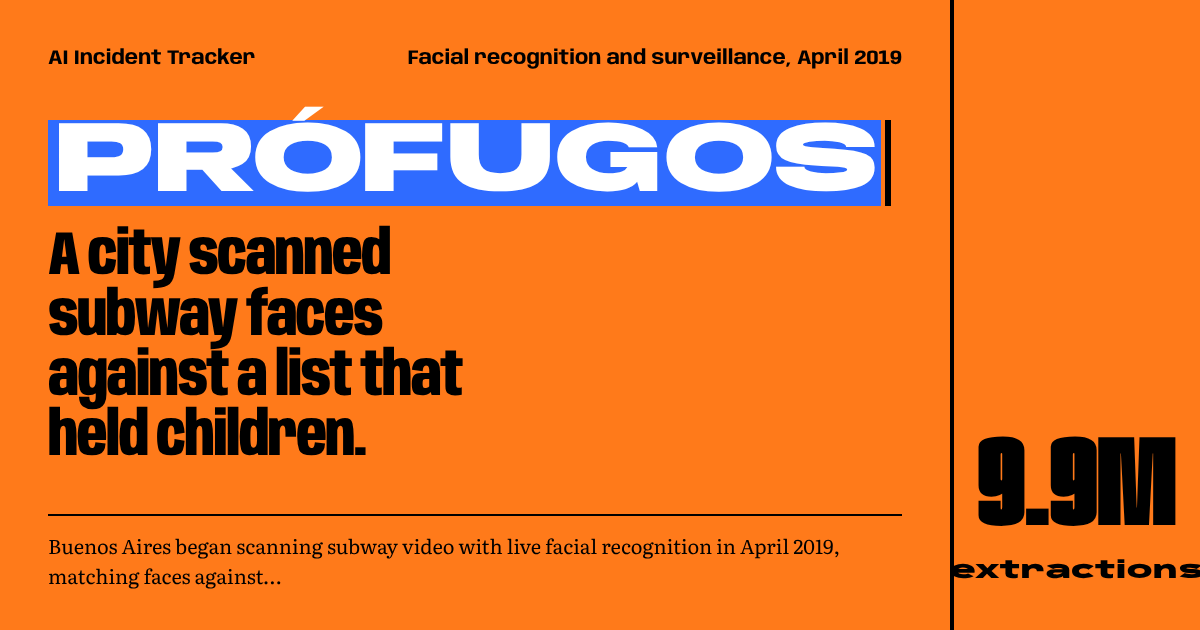
Buenos Aires began scanning subway video with live facial recognition in April 2019, matching faces against Argentina's national fugitives database. Human Rights Watch found in 2020 that the database listed children. In 2022 a city judge suspended the system, and a court declared the resolution creating it unconstitutional for lacking legal safeguards. An appeals court set conditions in 2023, including tests for unequal impact, before any restart.
On April 24, 2019, Buenos Aires launched its Sistema de Reconocimiento Facial de Prófugos, which compared faces from subway cameras against CONARC, Argentina's national database of people with outstanding arrest warrants. In October 2020 Human Rights Watch reported that CONARC listed at least 166 children added between 2017 and 2020, published online with their names, and contained errors. The city's security ministry denied that the system held minors' data.
Digital rights group ODIA and others sued. On April 11, 2022, Judge Roberto Gallardo suspended the system, and an expert review of its records followed. The court later cited about 9.9 million extractions of biometric data by the city between April 2019 and March 2022, and about 15,459 people loaded into the system who did not appear in CONARC. The city said the system had helped locate 1,695 fugitives.
In September 2022 a city court declared unconstitutional the resolution creating the system, finding it was set up without legally required safeguards such as a legislative oversight commission, and voided actions taken under it. In April 2023 an appeals panel largely upheld the ruling. It required the oversight bodies to be working, tests of the software for unequal impact by personal characteristics, and public disclosure of how the system works before any restart.
- Dated
- September 7, 2022
- Ruling
- Article 1 of Resolution 398/19 unconstitutional
- Expert finding
- About 15,459 people loaded who were not in CONARC
- Restart
- Only once oversight bodies are working
How it unfolded
- Apr. 24, 2019
Live facial recognition starts in the subway.
- Oct. 2020
Human Rights Watch finds children in CONARC.
- Apr. 11, 2022
A judge suspends the system.
- Sept. 2022
A court declares its legal basis unconstitutional.
- Apr. 2023
An appeals panel sets conditions for any restart.
Provenance
Where each fact comes from, and what is still missing.
On the record
The court rulings document the suspension, the expert findings and the conditions for any restart; Human Rights Watch documented children in CONARC.Not yet confirmed
How the extra biometric queries were used, and whether any wrongful arrests followed from the children's entries, has not been established. Send us a sourceSources
- News report
La Nación, April 12, 2022. Por un fallo judicial suspendieron el sistema de reconocimiento facial en la ciudad de Buenos Aires. Read - Official record
Gobierno de la Ciudad de Buenos Aires, April 19, 2022. Reconocimiento facial: el gobierno de la Ciudad recusó al juez Roberto Gallardo. Read - Official record
Cámara de Apelaciones en lo Contencioso Administrativo, Tributario y de Relaciones de Consumo (via Ministerio Público de la Defensa), April 2023. O.D.I.A. y otros c/ GCBA s/ amparo, Cámara de Apelaciones CAyTRC, Sala I. Read - Official record
Juzgado CAyT N.º 4, Ciudad de Buenos Aires (via Ministerio Público de la Defensa), September 7, 2022. O.D.I.A. y otros c/ GCBA s/ amparo, sentencia. Read - News report
MIT Technology Review, October 9, 2020. Live facial recognition is tracking kids suspected of being criminals. Read - News report
Human Rights Watch, October 9, 2020. Argentina: Child Suspects' Private Data Published Online. Read - News report
MercoPress, October 10, 2020. Controversy in Buenos Aires City over live facial recognition to identify minors. Read - Incident index
AI Incident Database, April 24, 2019. AIID incident #76. Read
Rewritten and checked Nov 25, 2026. First published Nov 19, 2026.
Status history
Changes to this exhibit's status, with the date and what changed it.
- Nov 25, 2026Written up in full and checked against the September 2022 and April 2023 court rulings, the city government's statement, Human Rights Watch and La Nación. Added the court challenge and its outcome. Title rewritten. Status: official record.Juzgado CAyT N.º 4, Ciudad de Buenos Aires (via Ministerio Público de la Defensa); Cámara de Apelaciones en lo Contencioso Administrativo, Tributario y de Relaciones de Consumo (via Ministerio Público de la Defensa); Gobierno de la Ciudad de Buenos Aires; Human Rights Watch; La Nación
- Nov 21, 2026Checked against Human Rights Watch and MercoPress and summarized in our own words.Human Rights Watch; MercoPress
- Nov 19, 2026Imported from the AI Incident Database (incident 76) with the reports it lists.AI Incident Database
Questions visitors ask
Is Buenos Aires' facial recognition system legal?
A city court declared its legal basis unconstitutional in September 2022, and an appeals panel in 2023 conditioned any restart on oversight bodies, bias testing and public disclosure.
Did the system's database include children?
Human Rights Watch reported in 2020 that CONARC, the fugitive database it used, listed at least 166 children added between 2017 and 2020.
Why was the system suspended?
In April 2022 Judge Roberto Gallardo suspended it in a case brought by ODIA; an expert review later found queries and entries beyond the fugitive list.
Take it with you
Share the cover
Cite this exhibit
AI Incident Tracker. (2026, November 25). Buenos Aires' live facial recognition used a fugitive database that listed children, and courts struck down how the city ran it (AIT-0235). https://aiincidenttracker.com/AIT-0235
Up next
More like this
See the room- Sep 15, 2025Kenya's High Court found the state broadcaster KBC unlawfully made staff clock in with facial recognition and ordered the data deletedFacial recognition and surveillance
- Mar 2022A São Paulo court suspended the Metro's planned facial recognition system, and an appeals judge kept the ban in placeFacial recognition and surveillance
- Apr 2019FTC said the Ever photo app ran facial recognition on users' photos by default, and its maker settledFacial recognition and surveillance
- Jan 9, 2025A Nebraska man was jailed after a Kentucky detective allegedly relied on a facial recognition match, and a judge let his lawsuit proceedFacial recognition and surveillance