Colombia's Supreme Court reassigned a case after an AI-assisted draft conviction surfaced before the trial ended
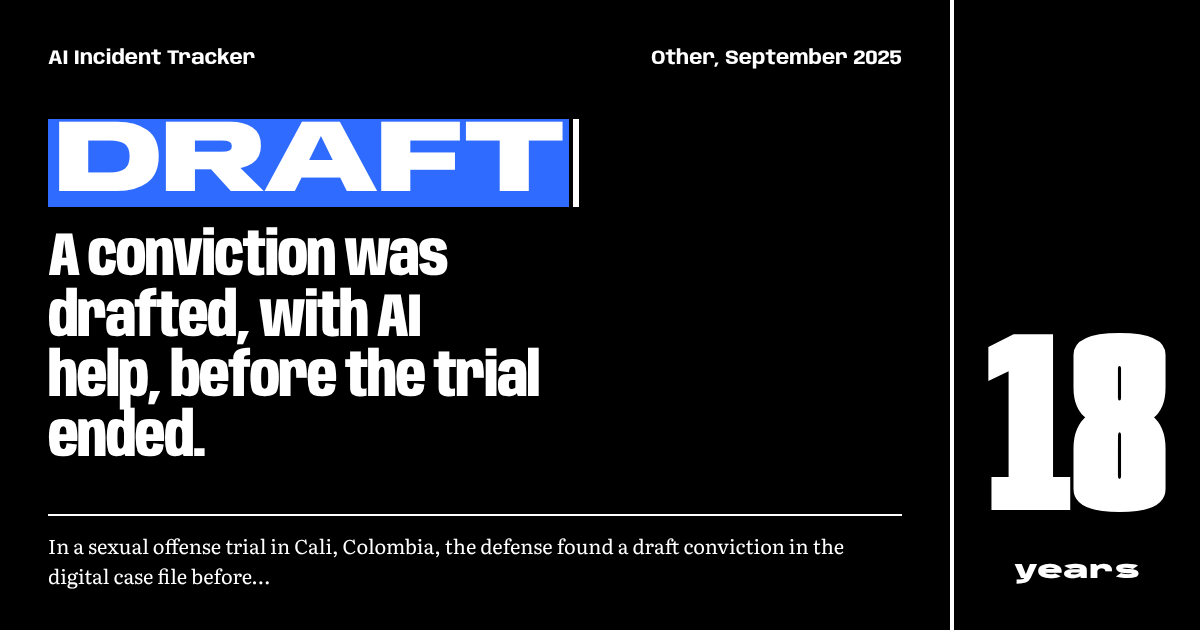
In a sexual offense trial in Cali, Colombia, the defense found a draft conviction in the digital case file before closing arguments. It proposed 18 years in prison, described hearings that had not happened as already held, and included an analysis of the victim's testimony that appeared to come from generative AI. On December 2, 2025, Colombia's Supreme Court held this broke the appearance of impartiality, annulled rulings rejecting the defense's recusal request and ordered another judge to take the case.
In a criminal trial before a circuit court in Cali, closing arguments were set for September 19, 2025. While preparing them, the defense found a draft conviction already in the digital case file. Signed by the judge, it found guilt proven beyond reasonable doubt, proposed 18 years in prison and described the closing and verdict hearings as already held.
Part of the draft, an assessment of the victim's testimony, appeared to have been produced with generative AI; it opened with a chatbot-style line thanking the user for sharing the testimony. The defense asked for the judge's recusal, which was rejected, and a tutela court in Cali denied the defendant's challenge in October 2025.
On December 2, 2025, a tutela chamber of the Supreme Court's criminal division reversed. It held that a conviction drafted before closing arguments emptied those arguments of meaning and broke the appearance of impartiality, violating due process. It annulled the rulings rejecting the recusal, sent the case to another judge, and warned the trial court to follow the judiciary's AI rules, which bar AI from replacing a judge's assessment of evidence.
- Date
- December 2, 2025
- Draft
- Conviction with 18-year sentence before closing arguments
- AI use
- Testimony analysis apparently generated with AI
- Orders
- Recusal rulings annulled; case reassigned
How it unfolded
- Sept. 19, 2025
The defense finds the draft and seeks recusal.
- Oct. 23, 2025
A Cali tutela court denies the challenge.
- Dec. 2, 2025
The Supreme Court finds due process violated.
- Feb. 10, 2026
The ruling is reported.
Provenance
Where each fact comes from, and what is still missing.
On the record
The Supreme Court's ruling describes the draft, the AI-assisted passage and its orders.Not yet confirmed
Which AI tool was used, and whether the judge faced discipline, are not in the sources we read. Send us a sourceSources
- Court record
ambitojuridico.com, December 2, 2025. STP21973-2025. Read, archived copy - News report
Sara Valentina Quevedo Delgado, El Tiempo, February 10, 2026. Las claves del reproche de la Corte Suprema por un borrador de condena hecho con IA antes de concluir el juicio. Read, archived copy - News report
El Cronista, February 12, 2026. Corte Suprema pone freno a una escandalosa sentencia hecha con inteligencia artificial: nueva regulación para su uso. Read, archived copy - Official record
archivodigitalapi.cortesuprema.gov.co, March 13, 2026. Relevantes. Read, archived copy - News report
Noticias RCN, February 10, 2026. Insólito: juez proyectó una condena con IA antes de terminar el juicio y fue apartado del caso. Read, archived copy - Incident index
AI Incident Database, September 19, 2025. AIID incident #1801. Read
Rewritten and checked Nov 24, 2026. First published Nov 19, 2026.
Status history
Changes to this exhibit's status, with the date and what changed it.
- Nov 24, 2026Written up in full and checked against the Supreme Court's ruling and its jurisprudence bulletin, El Tiempo and Noticias RCN. The court's bulletin is now typed as an official record and the ruling as a court record. Defendant not named. Status: official record.ambitojuridico.com; archivodigitalapi.cortesuprema.gov.co; El Tiempo; Noticias RCN
- Nov 19, 2026Imported from the AI Incident Database (incident 1801) with the reports it lists.AI Incident Database
- Nov 19, 2026Checked against El Tiempo and Noticias RCN and summarized in our own words.El Tiempo; Noticias RCN
Questions visitors ask
What happened in the Colombian AI draft conviction case?
Before closing arguments, the defense found a draft conviction in the case file, partly apparently written with generative AI, proposing 18 years in prison.
What did the Supreme Court decide?
In December 2025 it held that the draft broke the appearance of impartiality and violated due process, and ordered another judge to take the case.
Can Colombian judges use AI?
The court said judges may use AI with transparency and human control, but it may not replace their assessment of evidence or their decisions.
Take it with you
Share the cover
Cite this exhibit
AI Incident Tracker. (2026, November 24). Colombia's Supreme Court reassigned a case after an AI-assisted draft conviction surfaced before the trial ended (AIT-1891). https://aiincidenttracker.com/AIT-1891
Up next
More like this
See the room- Oct 2, 2026Nebraska Supreme Court Reportedly Struck Self-Represented Divorce Litigant's Appellate Brief Containing Purportedly AI-Generated Fictitious CitationsOther
- Jan 2018An Edinburgh supermarket ended a week-long trial of Fabio, a robot that gave unhelpful answers to shoppersOther
- 2016Arkansas swapped nurses for a computer algorithm to set home care hours, cutting care for disabled Medicaid recipients until courts stepped inOther
- Oct 2026Lawsuit alleges McDonald's AI-assisted pricing tool fixes U.S. menu prices; McDonald's says franchisees set pricesOther