England's exam regulator used an algorithm to set 2020 A-level grades, lowering many, before a government U-turn
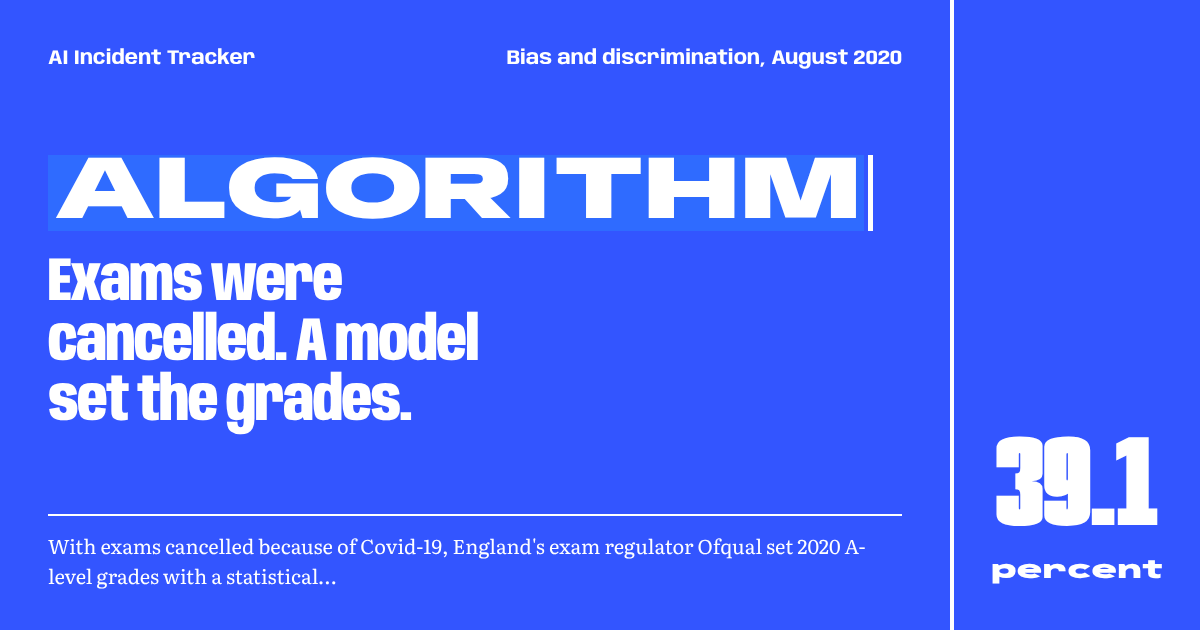
With exams cancelled because of Covid-19, England's exam regulator Ofqual set 2020 A-level grades with a statistical model built largely on schools' past results. When results came out on August 13, 39.1 percent of teachers' assessed grades had been lowered. Critics said the method favoured private schools and penalised students at larger state schools. Four days later the government and Ofqual switched to teacher-assessed grades, and Ofqual's chair apologised.
Covid-19 closed schools in England in March 2020 and summer exams were cancelled. Teachers submitted a grade and a ranking for each student, and Ofqual, the exam regulator, used a standardisation model to adjust those grades, leaning heavily on each school's results in earlier years.
A-level results came out on August 13. The model had lowered 39.1 percent of the teacher-assessed grades, and left 58.7 percent unchanged. Students who missed university offers protested, and critics said the method favoured private schools, where small classes were more often left with teachers' grades, and penalised strong students at larger state schools.
On August 17 the government and Ofqual agreed to drop the calculated grades. Students would get their teacher-assessed grade, or the calculated grade if it was higher. Revised A-level grades went to schools on August 19. Ofqual's chair, Roger Taylor, apologised to students.
- Published
- August 17, 2020
- Decision
- Revert to centre assessment grades
- A and AS levels
- Results of August 13 reissued
- GCSEs
- Centre assessment grades on results day
How it unfolded
- March 2020
Summer exams in England are cancelled.
- Aug. 13, 2020
A-level results: the model lowers 39.1 percent of teacher grades.
- Aug. 13 to 17
Students protest; missed university offers pile up.
- Aug. 17, 2020
The government and Ofqual switch to teacher-assessed grades.
- Aug. 19, 2020
Revised A-level grades go to schools.
“We understand this has been a distressing time for students”
Provenance
Where each fact comes from, and what is still missing.
On the record
The government's and Ofqual's announcements of August 17, 2020 set out the switch to teacher-assessed grades. The share of grades lowered comes from the results Ofqual published, as reported by Schools Week.Not yet confirmed
How much the model favoured particular kinds of school was argued over by critics and analysts; the figures here are the overall shares of grades lowered and unchanged. Send us a sourceSources
- Official record
GOV.UK, August 17, 2020. GCSE and A level students to receive centre assessment grades. Read, archived copy - Official record
Ofqual (GOV.UK), August 17, 2020. Statement from Roger Taylor, Chair, Ofqual. Read, archived copy - Official record
GOV.UK, August 27, 2020. Taking exams during the coronavirus (COVID-19) outbreak. Read, archived copy - News report
Schools Week, August 13, 2020. A-level results 2020: Top grades up by 2.4 percentage points, but 39.1% of grades downgraded. Read - News report
The Guardian, August 15, 2020. Controversial exams algorithm to set 97% of GCSE results. Read - News report
BBC, August 17, 2020. A-levels and GCSEs: How did the exam algorithm work?. Read, archived copy - News report
The Verge, August 17, 2020. UK ditches exam results generated by biased algorithm after student protests. Read, archived copy - News report
CNBC, August 21, 2020. How a computer algorithm caused a grading crisis in British schools. Read, archived copy - News report
dl.acm.org, June 20, 2022. The Algorithmic Imprint. Read, archived copy - News report
Nick Summers, Engadget, August 18, 2020. How the UK's algorithm-based grading fell apart. Read, archived copy - News report
Kieren McCarthy, The Register, August 17, 2020. UK govt reboots A Level exam results after computer-driven fiasco: Now teacher-predicted grades will be used after all. Read, archived copy - Incident index
AI Incident Database, August 13, 2020. AIID incident #374. Read
Rewritten and checked Nov 24, 2026. First published Nov 19, 2026.
Status history
Changes to this exhibit's status, with the date and what changed it.
- Nov 24, 2026Written up in full and checked against the UK government's and Ofqual's August 17, 2020 announcements and Schools Week's report of the results. Status: official record.GOV.UK
- Nov 20, 2026Checked against Engadget and The Register and summarized in our own words.Engadget; The Register
- Nov 19, 2026Imported from the AI Incident Database (incident 374) with the reports it lists.AI Incident Database
Questions visitors ask
What was the 2020 A-level algorithm?
A statistical model Ofqual used to adjust teachers' predicted grades after Covid-19 cancelled exams. It relied heavily on each school's results in earlier years.
How many A-level grades did the algorithm lower?
39.1 percent of teacher-assessed grades were lowered and 58.7 percent stayed the same, according to the results Ofqual published, as reported by Schools Week.
Why was the algorithm called unfair?
Critics said it favoured private schools, where small classes were more often left with teachers' grades, and marked down strong students at schools with weaker past results.
What happened after the U-turn?
On August 17, 2020, the government and Ofqual said students would get their teacher-assessed grade, or the calculated grade if it was higher. Revised A-level grades went to schools on August 19.
Take it with you
Share the cover
Cite this exhibit
AI Incident Tracker. (2026, November 24). England's exam regulator used an algorithm to set 2020 A-level grades, lowering many, before a government U-turn (AIT-0523). https://aiincidenttracker.com/AIT-0523
Up next
More like this
See the room- Jan 2, 2021Bologna court ruled Deliveroo's rider-ranking algorithm was discriminatory for penalising lawful absencesBias and discrimination
- Sep 2020Twitter's image-cropping algorithm favored white people and women, the company's own researchers foundBias and discrimination
- Nov 2019Apple Card users alleged gender bias in credit limits, and New York regulators later found no unlawful discriminationBias and discrimination
- 2013Dutch tax authority's fraud algorithm treated non-Dutch nationality as a risk in a childcare benefits scandalBias and discrimination