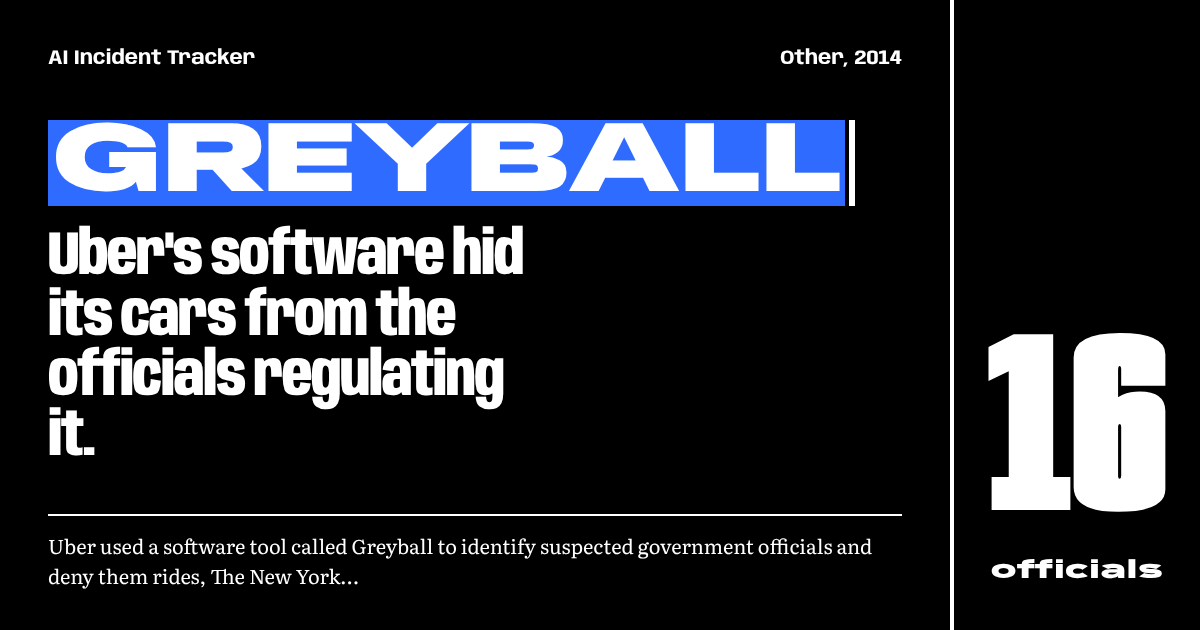
Uber used a secret tool called Greyball to deny rides to suspected officials; Portland found it tagged 16 government officials
Uber used a software tool called Greyball to identify suspected government officials and deny them rides, The New York Times reported in March 2017. Uber said the program targeted users who broke its terms, including officials running secret stings. A Portland Bureau of Transportation audit found Uber tagged 17 rider accounts during its unpermitted December 2014 launch there, 16 belonging to government officials. Portland imposed no fines.
Greyball was part of an Uber program called VTOS, for violation of terms of service, which began as early as 2014 and was approved by Uber's general counsel. It used data from the Uber app to identify riders Uber suspected were regulators or police, who could then be shown fake cars or none. The New York Times revealed it on March 3, 2017, reporting its use in cities including Portland, Boston, Paris and Las Vegas.
Uber said the program denied rides to users who broke its terms, including officials running secret stings. Portland's mayor and transportation commissioner ordered an audit. The Portland Bureau of Transportation's April 28, 2017 report found that Uber tagged 17 rider accounts, 16 of them government officials, between December 5 and 19, 2014, when it was operating in the city without permits.
The report said 29 ride requests by city enforcement officers were denied; Uber's own records showed three tagged riders requesting rides and being refused. It found no evidence Uber or Lyft used such tools after April 2015, when Uber returned under a pilot program. Portland imposed no fines. The U.S. Attorney's office in San Francisco told the city Uber was the subject of a federal inquiry.
- Dated
- April 28, 2017
- Greyball period
- December 5 to 19, 2014
- Accounts tagged
- 17, of which 16 were government officials
- Requests denied
- 29 by city enforcement officers
- Federal inquiry
- U.S. Attorney, Northern District of California
How it unfolded
- Dec. 5, 2014
Uber starts unpermitted service in Portland.
- Dec. 21, 2014
Uber stops operating in Portland.
- Apr. 24, 2015
Greyball tags removed as a pilot begins.
- Mar. 3, 2017
The New York Times reveals Greyball.
- Apr. 28, 2017
Portland audit finds 16 officials tagged.
Provenance
Where each fact comes from, and what is still missing.
On the record
Portland's audit confirms Uber tagged 17 rider accounts in December 2014, 16 of them identified as government officials.Not yet confirmed
Greyball's use in other cities rests on press reports; Portland's audit covered Portland only. Send us a sourceSources
- Official record
Portland Bureau of Transportation (via Courthouse News Service), April 28, 2017. Greyball Audit Report. Read - News report
Fortune, September 15, 2017. Portland probe finds Uber used software to evade 16 government officials. Read - News report
The Associated Press (via The Washington Times), May 5, 2017. Feds probe Uber's use of fake app to stymie city inspectors. Read - News report
The New York Times, March 3, 2017. How Uber Deceives the Authorities Worldwide. Read - News report
The Guardian, March 4, 2017. Greyball: how Uber used secret software to dodge the law. Read - News report
Jonathan Vanian, Fortune, March 3, 2017. Uber Has Reportedly Evaded Authorities With a Secret Program. Read - Incident index
AI Incident Database, October 1, 2014. AIID incident #334. Read
Rewritten and checked Nov 26, 2026. First published Nov 19, 2026.
Status history
Changes to this exhibit's status, with the date and what changed it.
- Nov 26, 2026Written up in full and checked against the Portland Bureau of Transportation's April 2017 Greyball audit report, The New York Times, Fortune and the Associated Press. Added Portland's findings. Title rewritten. Status: official record.Portland Bureau of Transportation (via Courthouse News Service); Fortune; The Associated Press (via The Washington Times); The New York Times; Fortune
- Nov 20, 2026Checked against Fortune and summarized in our own words.Fortune
- Nov 19, 2026Imported from the AI Incident Database (incident 334) with the reports it lists.AI Incident Database
Questions visitors ask
What was Uber's Greyball?
A tool in an Uber program called VTOS that used app data to identify riders Uber suspected were regulators or police and deny them rides, sometimes by showing fake cars.
What did Portland find?
Its April 2017 audit found Uber tagged 17 rider accounts during its unpermitted December 2014 launch, 16 of them government officials, and that officers' ride requests were denied.
Was Uber penalized?
Portland imposed no fines and found no evidence of Greyball use after April 2015. It recommended code changes so future evasion could bring fines or loss of a permit.
Take it with you
Share the cover
Cite this exhibit
AI Incident Tracker. (2026, November 26). Uber used a secret tool called Greyball to deny rides to suspected officials; Portland found it tagged 16 government officials (AIT-0486). https://aiincidenttracker.com/AIT-0486
Up next
More like this
See the room- Jul 20, 2020UK Uber drivers sued in Amsterdam for their data and an explanation of its automated profiling, and won on appeal in 2023Other
- Nov 17, 2026NSA's classified internal network went down during patching that U.S. officials tied to an AI-found PHP flawOther
- Feb 2022Uber's 'Upfront Fares' algorithm set driver pay in 24 U.S. cities, and some drivers said they earned lessOther
- Nov 14, 2023UnitedHealth was sued over its nH Predict algorithm, and a Senate report found nursing-home denials rose ninefold as naviHealth took overOther