Chicago police scored about 400,000 people with a violence-risk model the city's inspector general called unreliable
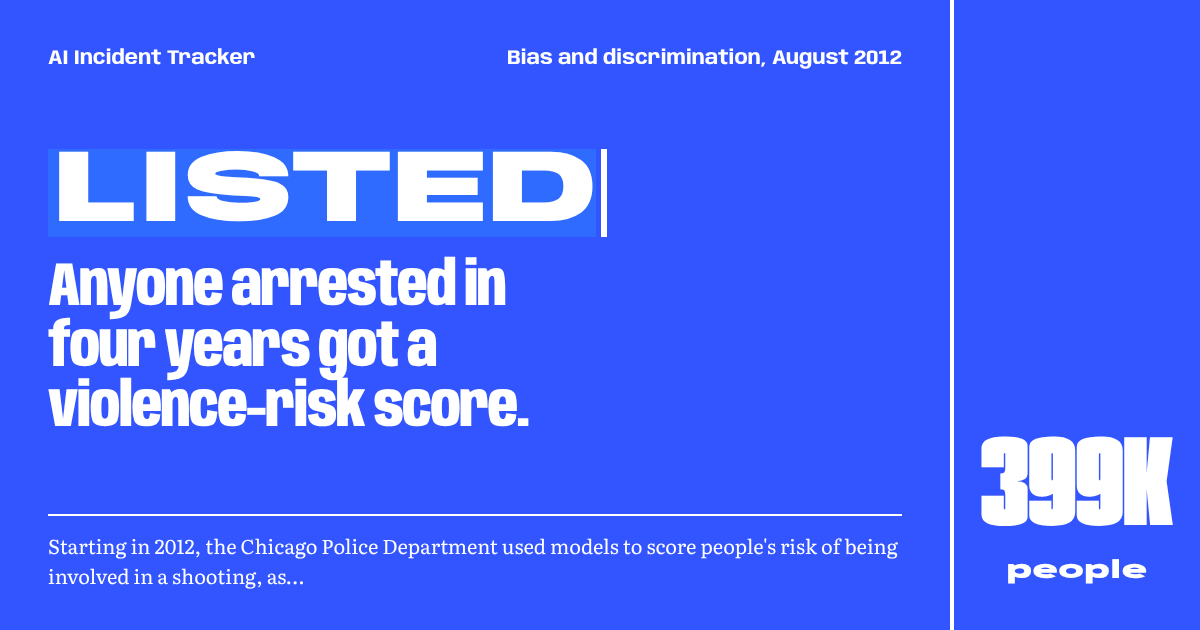
Starting in 2012, the Chicago Police Department used models to score people's risk of being involved in a shooting, as shooter or victim. By July 2018, 399,412 people had a Strategic Subject List score. A 2016 RAND study of an early version found people on the list were no more likely to be shot, but were more often arrested for shootings. The city's inspector general found serious flaws, and police stopped using the scores in November 2019.
In 2012 the Chicago Police Department began using statistical models, developed with federal grant money, to estimate people's risk of being a party to violence, either as a shooter or as a victim. The best known was the Strategic Subject List; a later version was called the Crime and Victimization Risk Model.
Everyone arrested in the previous four years was scored. By July 2018, 399,412 people had a Strategic Subject List score, and by March 2019, 313,513 had a risk tier under the newer model. The list was largely kept from the public until 2017, when the department released a version after a lawsuit by the Chicago Sun-Times.
A 2016 RAND study of an early version found that people on the list were no more likely to be shot, but were more likely to be arrested for a shooting.
In August 2019 the department told the city's inspector general it would stop using the models when its grant ran out, and it did so on November 1, 2019. In a January 23, 2020 advisory, the inspector general found the department had not trained officers on what the scores meant, had not updated them between August 2016 and January 2019, and had never fully disclosed the factors behind them.
- Dated
- January 23, 2020
- People scored
- 399,412 (July 2018)
- Ended
- November 1, 2019
How it unfolded
- 2012
Chicago police begin scoring people's risk of gun violence.
- 2016
A RAND study finds people on the list were no more likely to be shot.
- 2017
A version of the list is released after a lawsuit.
- Nov. 1, 2019
The department stops using the models.
- Jan. 23, 2020
The inspector general publishes its advisory.
Provenance
Where each fact comes from, and what is still missing.
On the record
The inspector general's advisory gives the number of people scored, the timeline and its findings on training, updates and disclosure. RAND's findings come from its 2016 study as reported.Not yet confirmed
How the scores were used in individual stops, arrests or charging decisions is not documented in the sources we read. Send us a sourceSources
- Official record
City of Chicago Office of Inspector General, January 23, 2020. Advisory Concerning the Chicago Police Department's Predictive Risk Models (PDF). Read - News report
Associated Press (via KSL), January 2020. Chicago police end effort to predict gun offenders, victims. Read - News report
The Guardian, February 4, 2016. Police data could be labelling 'suspects' for crimes they have not committed. Read - News report
Chicago Tribune, August 17, 2016. Study Casts Doubt on Chicago Police’s Secretive “Heat List”. Read - News report
The Verge, August 19, 2016. Chicago’s predictive policing tool just failed a major test. Read - News report
rss.onlinelibrary.wiley.com, October 7, 2016. To predict and serve?. Read - News report
USA Today, December 3, 2016. Predictive policing violates more than it protects: Column. Read - News report
Michael Reilly, MIT Technology Review, August 19, 2016. Chicago's Experiment in Predictive Policing Isn't Working. Read - News report
Justin Bull and Miles Bryan, WBEZ, August 19, 2016. New Study Says Chicago Police's 'Heat List' Inaccurate, Ineffective. Read - Official record
City of Chicago Office of Inspector General, January 23, 2020. Advisory Concerning the Chicago Police Department's Predictive Risk Models. Read - Incident index
AI Incident Database, August 1, 2012. AIID incident #433. Read
Rewritten and checked Nov 24, 2026. First published Nov 19, 2026.
Status history
Changes to this exhibit's status, with the date and what changed it.
- Nov 24, 2026Written up in full and checked against the inspector general's January 2020 advisory, reporting on RAND's 2016 study and the AP. Status: official record.City of Chicago Office of Inspector General
- Nov 21, 2026Checked against MIT Technology Review, WBEZ and the City of Chicago Office of Inspector General and summarized in our own words.MIT Technology Review; WBEZ; City of Chicago Office of Inspector General
- Nov 19, 2026Imported from the AI Incident Database (incident 433) with the reports it lists.AI Incident Database
Questions visitors ask
What was Chicago's Strategic Subject List?
A Chicago Police Department model that scored people's risk of being involved in a shooting, as shooter or victim. Everyone arrested in the previous four years was scored, nearly 400,000 people by July 2018.
Did the Strategic Subject List work?
A 2016 RAND study of an early version found people on the list were no more likely to be shot, but were more likely to be arrested for a shooting. The inspector general later found the department had not trained officers on the scores or kept them updated.
Is it still in use?
No. The department stopped using the models on November 1, 2019, when its federal grant funding ended.
Take it with you
Share the cover
Cite this exhibit
AI Incident Tracker. (2026, November 24). Chicago police scored about 400,000 people with a violence-risk model the city's inspector general called unreliable (AIT-0582). https://aiincidenttracker.com/AIT-0582
Up next
More like this
See the room- Oct 4, 2022Edmonton police released, then withdrew, a DNA-generated face of a Black suspect after racial profiling criticismBias and discrimination
- 2021NarxCare overdose risk scores came under scrutiny after patients said they were denied pain medicationBias and discrimination
- May 23, 2016ProPublica found COMPAS risk scores in Broward County wrongly flagged Black defendants as future criminals more oftenBias and discrimination
- Oct 15, 2024Rights groups asked France's Council of State to halt the CNAF welfare agency's risk-scoring algorithm, and 25 organisations had joined by 2026Bias and discrimination