Automated sell order helped set off the 2010 Flash Crash in U.S. stock markets, regulators found
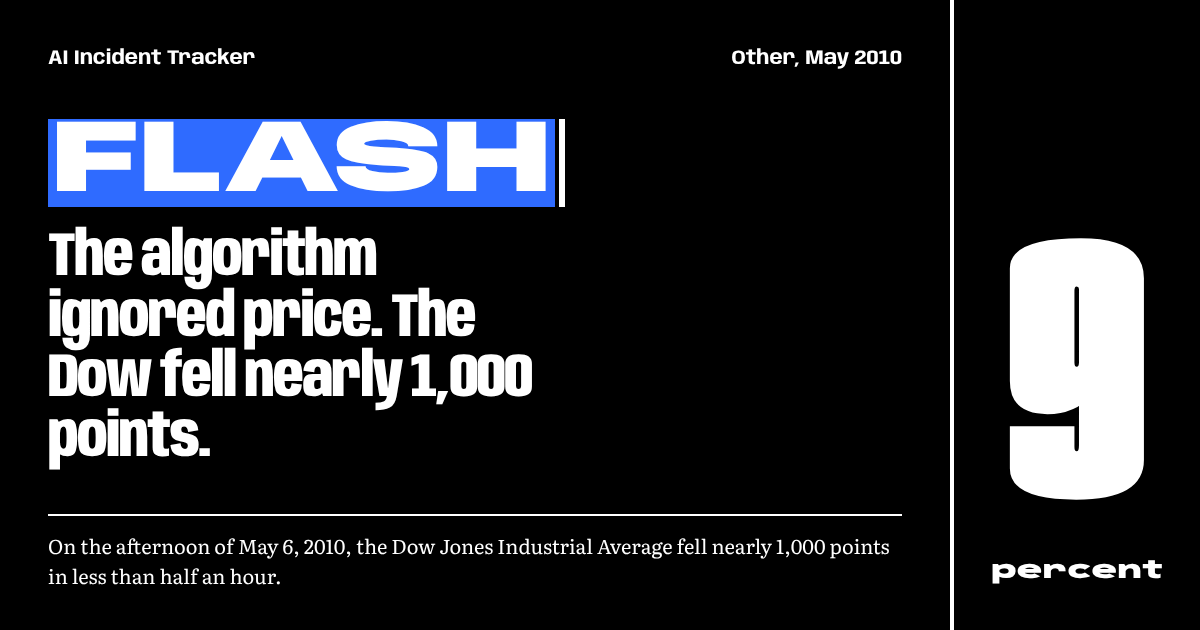
On the afternoon of May 6, 2010, the Dow Jones Industrial Average fell nearly 1,000 points in less than half an hour. The drop briefly erased about $1 trillion in market value before much of the loss was recovered. An SEC and CFTC staff report traced it to a large trader's automated sell program in E-Mini futures. The algorithm fed 75,000 contracts, worth about $4.1 billion, into the market without regard to price or time.
May 6, 2010, was already a nervous day. U.S. stocks were down on worries about Greece's debt crisis, and by about 2:30 p.m. the Dow was off about 2.5 percent. Around then, a large trader began selling 75,000 E-Mini S&P 500 futures contracts, worth about $4.1 billion.
It used an automated execution algorithm set to sell at a rate of 9 percent of the previous minute's trading volume, without regard to price or time. High-frequency traders bought contracts and then quickly resold them to one another, creating what regulators called a hot-potato effect: in 14 seconds after 2:45:13 p.m. they traded more than 27,000 contracts while adding only about 200 to their net holdings.
Buyers vanished. In less than half an hour the Dow fell nearly 1,000 points, and about 30 stocks in the S&P 500 dropped at least 10 percent within five minutes. Markets then recovered much of the loss, and the Dow closed down 348 points.
In a joint report released on September 30, 2010, the staffs of the SEC and CFTC concluded that under stressed conditions, the automated execution of a large sell order can trigger extreme price movements, especially when the algorithm does not take price into account.
- Released
- September 30, 2010
- Sell program
- 75,000 E-Mini contracts, about $4.1 billion
- Execution rate
- 9% of the previous minute's volume
- Hot potato
- 27,000+ contracts in 14 seconds
How it unfolded
- 2:30 p.m.
A large trader starts an automated sell program in E-Mini futures.
- 2:45 p.m.
High-frequency traders pass contracts back and forth.
- Minutes later
The Dow is down nearly 1,000 points, then rebounds.
- May 18, 2010
Regulators publish preliminary findings.
- Sept. 30, 2010
The SEC and CFTC staffs release their report.
“high trading volume is not necessarily a reliable indicator of market liquidity”
Provenance
Where each fact comes from, and what is still missing.
On the record
The SEC and CFTC staff report sets out the sell program, the algorithm's settings, the hot-potato trading and the price moves.Not yet confirmed
The report did not name the trader. Send us a sourceSources
- Official record
Commodity Futures Trading Commission, September 30, 2010. Staff report on May 6, 2010 market events. Read - News report
Associated Press (via MPR News), October 1, 2010. One large trader led to May 6 stock market plunge. Read - News report
CNNMoney, October 1, 2010. Trading program sparked May 'flash crash'. Read - Official record
U.S. Securities and Exchange Commission, September 30, 2010. Findings Regarding the Market Events of May 6, 2010. Read - News report
Wikipedia, May 8, 2010. 2010 Flash Crash. Read - News report
AOL.com, August 19, 2010. The 2010 Flash Crash: What Caused It and How to Prevent the Next One. Read - News report
CNBC, May 5, 2011. What Really Caused the Flash Crash. Read - News report
The Guardian, April 22, 2015. The 2010 'flash crash': how it unfolded. Read - News report
NPR, October 1, 2010. The Flash Crash, Explained. Read - Incident index
AI Incident Database, May 8, 2010. AIID incident #28. Read
Rewritten and checked Nov 24, 2026. First published Nov 19, 2026.
Status history
Changes to this exhibit's status, with the date and what changed it.
- Nov 24, 2026Written up in full and checked against the SEC and CFTC staff report and reporting by CNNMoney and the AP. Status: official record.U.S. Securities and Exchange Commission
- Nov 20, 2026Checked against the SEC and CFTC staff report and NPR and summarized in our own words.U.S. Securities and Exchange Commission; NPR
- Nov 19, 2026Imported from the AI Incident Database (incident 28) with the reports it lists.AI Incident Database
Questions visitors ask
What caused the 2010 Flash Crash?
An SEC and CFTC staff report traced it to a large trader's automated sell program: 75,000 E-Mini futures contracts, about $4.1 billion, fed into a stressed market by an algorithm that ignored price and time. High-frequency traders then passed contracts rapidly among themselves as buyers disappeared.
How far did the market fall?
The Dow Jones Industrial Average fell nearly 1,000 points in less than half an hour, briefly erasing about $1 trillion in value, before recovering much of the loss to close down 348 points.
Why is the Flash Crash on an AI incident list?
It is an early, well-documented case of automated decision-making in markets causing harm at speed: an execution algorithm and high-frequency trading systems interacting in ways no single human chose.
Take it with you
Share the cover
Cite this exhibit
AI Incident Tracker. (2026, November 24). Automated sell order helped set off the 2010 Flash Crash in U.S. stock markets, regulators found (AIT-0187). https://aiincidenttracker.com/AIT-0187
Up next
More like this
See the room- Oct 29, 2018Lion Air 737 Max crash killed 189 after a system fed by one misaligned sensor repeatedly pushed the nose down, investigators foundOther
- May 26, 2017Budapest Bank used AI to read callers' emotions without proper notice, Hungary's privacy regulator foundOther
- Oct 12, 2025Reportedly Fatal Xiaomi SU7 Ultra Crash in Chengdu Purportedly Involves Automated Driving Failure and Door Lock MalfunctionOther
- Oct 2, 2022Glovo sent an automated dismissal email to a Florence delivery rider after he died in a crashOther