UK race commission found St George's medical school's admissions program downgraded women and minority applicants
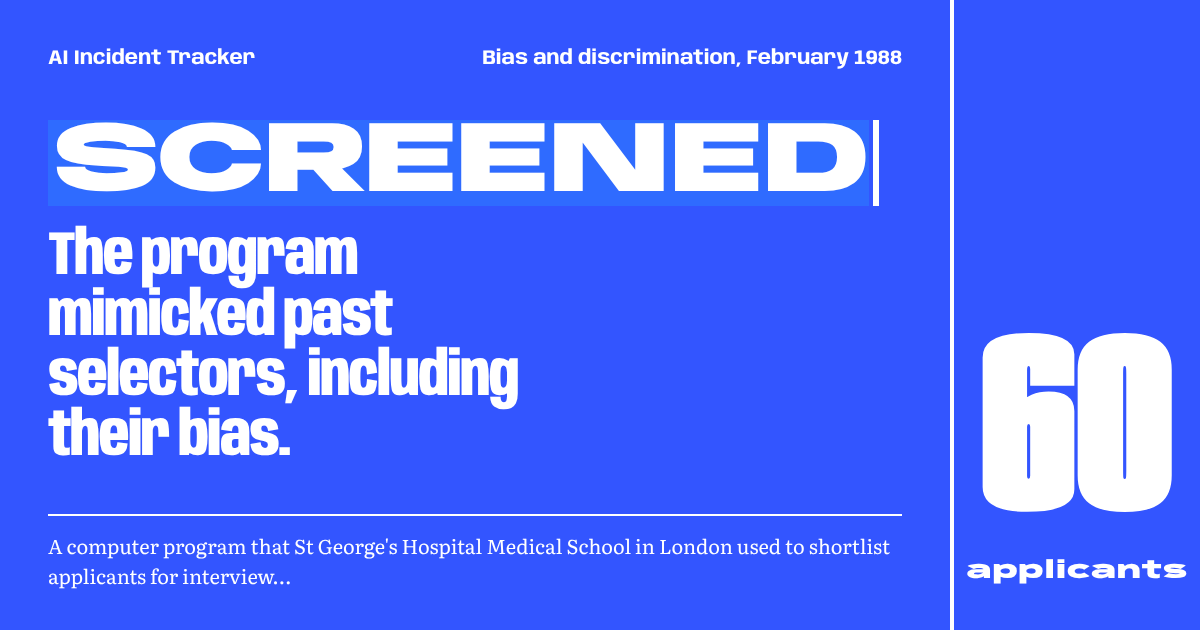
A computer program that St George's Hospital Medical School in London used to shortlist applicants for interview downgraded women and candidates it judged non-Caucasian from their surnames or birthplaces. The Commission for Racial Equality published its findings on February 25, 1988. As many as 60 applicants a year may have been refused an interview because of their sex or race, the BMJ said. The school accepted the bias was proven and revised its admissions procedures.
St George's Hospital Medical School received about 2,000 applications a year. To reduce the work of choosing whom to interview, a member of staff wrote a computer program to do the first screening. It was brought in after it was shown to correlate 90 to 95 percent with the school's traditional selection.
That match was the problem. In December 1986 two senior lecturers at the school told the Commission for Racial Equality that the program discriminated against women and people with non-European sounding names. The school did not record applicants' ethnicity, so the program inferred it from surnames, birthplaces and similar details.
The commission published its findings on February 25, 1988. The program downgraded the scores of women and of candidates it classed as non-Caucasian, and as many as 60 applicants a year may have been refused an interview because of their sex or race. As the BMJ put it, the program was not adding new bias but reflecting bias already in the system.
The school accepted that the bias was proven and revised its admissions procedures, the government told Parliament. The commission chose not to serve a non-discrimination notice, but recommended that staff using a computer program in selection find out what it contains.
- Inquiry by
- Commission for Racial Equality
- Report published
- February 25, 1988
- School's response
- Accepts bias proven; admissions revised
How it unfolded
- Before 1986
The school uses a computer program to shortlist applicants.
- Dec. 1986
Two lecturers report the bias to the commission.
- Feb. 25, 1988
The commission publishes its findings.
- Feb. 29, 1988
The government tells Parliament the school accepts the bias is proven.
“The school accepts that the allegations of bias are proven”
Provenance
Where each fact comes from, and what is still missing.
On the record
The government's written answer to Parliament confirms the commission's report and the school's acceptance. The BMJ's editorial sets out how the complaint arose, the scale of the effect and the commission's recommendations.Not yet confirmed
The full Commission for Racial Equality report is not available online in the sources we read; details come from the BMJ and Times Higher Education accounts of it. Send us a sourceSources
- News report
europepmc.org, March 5, 1998. A Blot on the Profession. Read - News report
marginalrevolution.com, August 17, 2013. Computers which magnify our prejudices. Read - News report
natbuckley.co.uk, March 27, 2016. Racist AI behaviour is not a new problem. Read - News report
read.dukeupress.edu, December 1, 2016. Racist in the Machine. Read - Official record
UK Parliament (Hansard), February 29, 1988. St. George's Medical School. Read - News report
Pat Younge, Times Higher Education, April 7, 1995. Figure it out. Read - Incident index
AI Incident Database, March 5, 1998. AIID incident #43. Read
Rewritten and checked Nov 24, 2026. First published Nov 19, 2026.
Status history
Changes to this exhibit's status, with the date and what changed it.
- Nov 24, 2026Written up in full and checked against the government's written answer to Parliament of February 29, 1988, the BMJ's editorial on the commission's report and Times Higher Education. Status: official record.UK Parliament (Hansard)
- Nov 21, 2026Checked against Hansard and Times Higher Education and summarized in our own words.UK Parliament (Hansard); Times Higher Education
- Nov 19, 2026Imported from the AI Incident Database (incident 43) with the reports it lists.AI Incident Database
Questions visitors ask
What happened at St George's medical school?
A computer program used to shortlist applicants for interview downgraded women and applicants it judged non-Caucasian from their names or birthplaces. The Commission for Racial Equality reported this in 1988.
Why did the program discriminate?
It was built to match the school's past human selections, with a 90 to 95 percent correlation, and so reproduced the bias already in those decisions.
What happened afterward?
The school accepted the bias was proven and revised its admissions procedures. The commission recommended that anyone using a computer program in selection find out what it contains.
Take it with you
Share the cover
Cite this exhibit
AI Incident Tracker. (2026, November 24). UK race commission found St George's medical school's admissions program downgraded women and minority applicants (AIT-0202). https://aiincidenttracker.com/AIT-0202
Up next
More like this
See the room- Oct 7, 2020BBC test found the UK's online passport photo checker rejected darker-skinned women's photos more oftenBias and discrimination
- Sep 2020Twitter's image-cropping algorithm favored white people and women, the company's own researchers foundBias and discrimination
- Apr 2015Study found Google Images under-represented women in results for 'CEO' and some other jobsBias and discrimination
- Dec 2021Justice Department found its PATTERN prisoner risk tool overpredicted reoffending for Black, Hispanic and Asian peopleBias and discrimination